So excited… Here is a mash up of my two favourite things, Climate Reality, and auto-tune superstar, Melodysheep.
This Earth is the one
we have to care about.
It is the only Earth
that we will ever have,
or love.
This Earth is the one
we have to care about.
It is the only Earth
that we will ever have.
She was the largest storm to hit the northeast US. Ever.
Why are we having 100 year storms, fires, floods and droughts, all in the same year?
Could something else be going on here?
It is time to end climate change silence.
It is happening, it is upon us. What will it take for us to wake up and take it seriously? Another record-breaking storm? Another devastating drought? More changes to arable land so that we can’t even grow enough food to feed ourselves?
There are forces against these wake-up calls – namely big oil and big corporates that trick us into wanting more, more, more. They fund political campaigns, they fund television commercials telling us that it is not all so bad, and they change public perception for their own interests.
Much to our own peril, we continue to listen to these corporations instead of the dire warnings of 97% of climate scientists. We continue to ignore the nagging notion in the back our heart that something is just not right.
Instead, we tell ourselves that our government has it under control, and that they will act in the best interests in the people and our future.
But our governments are not acting. They are ignoring climate change and its devastating consequences.
Who will have the courage to end their part in climate change silence?
Who among you will start talking about it, writing about it, getting mad about it?
Who will speak for the children who have no voice, yet will inherit this very scary and uncertain future?
On March 25th, 2011 I had a dream. A green dream. It went something like this:
I wake up in the morning, pull back the covers of my organic sheets, slip on my slippers that I knit from local wool, and then jump into a 3 minute luke warm shower to wash my hair using shampoo I made from my own liquid soap, using all natural ingredients. Then I pop into a cute bamboo dress that looks the same as when I bought it 10 years ago and go and wake up my kids. Walking into their rooms I notice their all natural toys, made from sustainable wood or other materials. I help them get dressed, in beautiful clothes made out of hemp and organic cotton, all locally made, some sewed with loving care by me. We trundle down the hall for breakfast. I pull out the local organic oatmeal, top it with some local honey, blueberries from our own bush and slug of local organic milk. We then all eat our breakfast as the sun shines into the kitchen, over the leaves of our indoor herb garden, and talk about what we want to do that day.
We decide to check out our garden first, so we slip on our handcrafted shoes and step outside. First we check the tomatoes, and the kids each pluck off a plump cherry tomato from the vine and pop it into their mouths. We take a look at how the cucumbers and herbs were coming along, before moving onto the raspberry patch. These had mostly been picked already and were now nicely preserved in our house in the form of jam and syrup, with a few extras frozen as well. Next we notice the zucchini, some of which needs to be picked. My son runs and gets the basket, and my daughter carefully twists a few of them off the plant. We decide to pull out some carrots and potatoes also. The peas and beans had all been picked, and the extras are also now preserved in our house. We walk on and notice that the apples will be ready soon. We are still getting some strawberries on our everbearing plants, so we pop a few into the basket, and a few more into our mouths. We stopped to notice the lilies, daisies and corabells, swaying in the gentle breeze. We decide to sit down for a while, and just soak in the sunshine and watch the birds flit about in our great big tree.
Before going back into the house, I look up to our roof, where a series of solar panels are also soaking up the rays. I smile with the knowledge that we are actually producing more power than we are using these days. As we walk around the house to go back in, we walk past our rainwater storage tank, used to water our garden, and vital for an emergency drought situation.
Back inside the kids and I decide to go to the new exhibit at the museum downtown. So I pack a light lunch of sandwiches made from homemade bread, some of our strawberries, some local cheese and water decanter for each. We set off for the bus stop. A hybrid bus pulls up to greet us and takes us off to our destination.
After the museum, we decide to pop into the library to pick out some books we are each interested in. On the bus ride home, we sit together and reflect what we saw and learned at the museum. Once home, the kids go off and do their own thing while I whip up a couple fresh new loaves of bread using local flour, and watch the birds out the window as I knead the dough, back and forth, back and forth. I set the dough to the side to rise for an hour or so, and then wash the dishes by hand using liquid soap I made myself. I then decide to put on a load of laundry into my ultra efficient washer, and use my homemade laundry soap. I hang up the clothes to dry on the line outside, where the sun is just starting to get a bit lower in the sky. I notice and appreciate each article of clothing as it passes through my hands.
My husband comes home, and is carrying a reusable glass jug of organic milk that he picked up on his walk home from the bus stop. I am just pulling the bread out of the oven, and the whole house is filled with the smell of bread goodness. We eat supper together – homemade pizza from local flour, topped with local organic goat cheese, tomato sauce I made last year from garden tomatoes and preserved, as well as other goodies from our garden. My husband and I savour a glass of cherry wine that we made ourselves last fall from our own cherry tree. Later on that evening, we all sit together and play music and talk to each other. I knit a new wool sweater for my daughter – it is a dark cherry red colour, and will be perfect for fall.
The sun starts to go down, so we switch on one LED powered light. The kids go off to bed. We pour another glass of wine and look out the window at the stars.
Well it has been quiet here on this little blog for a while… partly because life is busy and partly because I feel overwhelmed by the enormity of it all. I had to take a step back.
In the meantime, I have found an amazing artist that writes music and produces videos using clips from science based tv shows and documentaries. He makes science interesting and fun for kids. He has videos about dinosaurs, quantum physics, space, and the human brain! There are so many good ones. He also completed a contract with PBS where he did a remix of each of Mr. Rogers, Julia Childs and Bob Ross.
He is melodysheep on YouTube, and John Boswell in real life. He has just released his latest video, titled our Biggest Challenge, a video about climate change. I had to share.
To quote from his lyrics:
We can do this. We can change the world. Science offers us answers to these huge challenges.
Garbage. Waste. Where does it go? Where in the world does it end up? How much of the stuff are we each generating anyway?
Yes, it fills up landfills. Yes, big trucks have to haul it there. Yes, it releases loads of methane, which is 22 times worse than carbon dioxide for climate change. Then there are the oceans – for cities and countries that still dump their garbage into the ocean, shame on you! There is a gyre of plastic the size of Texas in the middle of the Pacific Ocean. Some of the plastic has broken up so small, fish cannot help but digest it.
The other thing with garbage is the needless waste of energy and resources that were used to make it, just so it can be thrown out. Where did this garbage originally come from? Where on Earth was it derived? What is the embodied energy of it, what emissions were created to bring it into existence? It seems like such a waste of resources, just to throw it away.
Waste is so wasteful.
So let’s reduce it where we can. Time for the sliding scale of green for garbage! Even small changes can make a big difference. Where do you fit on the green sliding scale?
Dabbler
You recycle. Things that are paper, cardboard, glass or plastic do not hit your garbage can. They hit the blue bag or recycling bin or recycling centre. I have been doing this since I had my own apartment. My Mom has been doing this for over 20 years.
Here is our recycling for a 3 week period in 2010, before I started getting serious on cutting the packaging…
Beginner
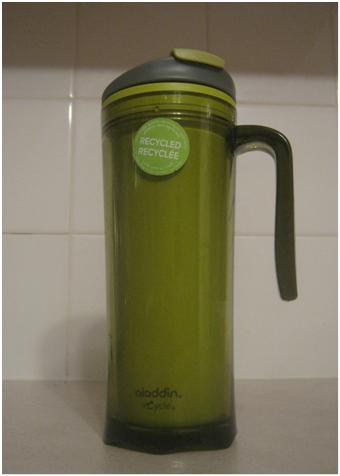
You avoid one use items such as paper coffee cups, paper napkins, paper towels and plastic forks. You avoid plastic bottles, especially ones with only a single serving, like water that comes out of the tap for free. You carry a travel mug for coffee, a water bottle for cold drinks. You use real dishes, and then wash them, and then use them again. I started doing this pretty hardcore with no excuses about a year and a half ago when I had my green epiphany. Here is my beloved green travel mug, which I use almost every day:
Intermediate
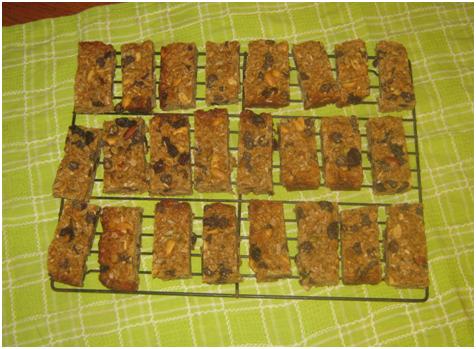
You bake. You make. You know how to cook. Homemade food always creates less garbage than pre-packaged and pre-processed, plus it is better for you and you know what is in it. Most garbage is created in the kitchen, and mostly from food packaging. Make it fresh and garbage free. I started making my bread about a year ago, and since then have tried all sorts of interesting things – tortillas, crackers, granola bars, buns, biscuits, muffins… I make a bunch, freeze it and then always have homemade snacks. Plus have you ever smelled fresh bread baking in your own house? They can’t bottle that smell, it is so good.
Hardcore
You compost your organic wastes. You have a small bin under the sink for those potato peels and banana peels, for old bread and eggshells, for kid’s leftovers and stuff that went bad in the fridge. Apple cores, carrot tops, onion skins, coffee grinds – they all go into the organics bin and then out to the backyard composter outside. If you live in an apartment you get some worms and have fun with worm composting (which makes an even richer organic matter). I toss my kitchen scraps into my composter outside all winter long. It freezes solid. I just layer some brown leaves over each donation, and then it is ready for more. In the spring the whole thing thaws and heats up and gets going again. A year full of organic wastes from the kitchen and yard get transformed into rich organic compost, the very best kind of dirt you can get. What kind of miracle of nature is that? Garbage to growing material, renewed again. None of it goes to the landfill – a closed loop system.
Ultimate
You don’t buy food with packaging. Full stop. Nothing in a box, nothing in a metal can, nothing in a plastic container, nothing in glass… You bring your own produce bags to the grocery store, you avoid processed foods, and you make your own soup. You also preserve your own food, allowing you to reuse glass canning jars for tomato sauce, salsa, jams, pickles and peaches. You bake your own bread, muffins, granola bars and snacks. You have barely any garbage or recycling, maybe a small bin every two weeks. The garbage man often skips your house. You start to wish that you paid for garbage collection on a per bag basis, because then it would be practically free…
Bonus Points
Do you get any bonus points?
You have been known to bring your own plastic containers to a restaurant to wrap up the leftovers.
If you get a take-out hamburger and fries, you fold up the paper wrap and cardboard and slip it into your purse or pocket to take it home to recycle. Then if courage permits, you go up and ask the store manager why they don’t have recycling bins?
You pack your kids garbage free lunches, with everything in containers and no prepackaged foods. No plastic wrap, no throw away containers, no tetra-pack juice boxes.
You use cloth diapers for your babies.
So where do you fall on the green sliding scale? We can reduce our garbage a lot just by thinking about it. Most of the garbage decisions are made at the grocery store, in the food packaging we haul home. If you don’t buy it, it will not end up in the bin!
Take the poll!
Want some inspiration? Here are some great low garbage superstars of the blogging world:
Clean Bin Project – this couple each created less than one small bin of garbage over an entire year, and made a documentary about it
My Plastic Free Life – seeing birds from the middle of the Pacific die with their with bellies full of plastic, she swore off the stuff in 2007 and just released a book about her journey
No Impact Man – he took his shopaholic, cappuccino drinking wife and young daughter on a ride to have no environmental impact for one year, and then wrote a book and made a film about it
Green as a Thistle – she made one green change a day for a year, and wrote a book about it called Sleeping Naked is Green.
Back to basics, back to going green. Green I tell ya, green! Let’s do it together and get some green sh*t done.
Over the years I have had a love-hate relationship with laundry. At age 10 or so my Mom used to make me help fold the odd load, and I hated it. Why do I have to fold these stupid towels, I didn’t dirty them. Why do I have to fold my sister’s clothes, when they are not mine?
Ha ha ha. If only my 10 year old self only knew the laundry mountains that awaited…
From about age 12 or so I did my own laundry. By that I mean picking up the contents of my floor, throwing it in the washer, forgetting it for a while, throwing it in the dryer, then using the dryer to find socks in the morning. Finally someone would nag me to take my laundry out of the dryer already so I would throw it in a laundry basket and continue to mine through it for socks each morning. Who needs a closet anyway?
Hey, I was twelve.
Since then I have matured somewhat and now I have a husband and two dirty darling little kids and I do all the laundry. I used to be on an “I’ll do it when I feel like it” sort of schedule. This worked for a while, until I stopped feeling like it, and then the mountains grew and grew and nobody had socks…
Then I turned all green and the laundry mountains came tumbling down. I have totally different relationship with laundry now. It has obtained a sort of zen like status. I can’t explain it. Somehow smoothing, hanging and folding clothes is very calming for me in a hectic, busy house. I do it exclusively in the laundry room, with no distractions. I have a schedule. I rock it.
How do you feel about laundry? Love or hate? At all green? How would you classify yourself on this sliding green scale:
Dabbler
You tend not to use dryer sheets. Those things are filled with chemicals anyway. That is why some people carry dryer sheets to keep bugs away. The bugs know better. You don’t want to smother everything that touches your skin with these things. You use dryer balls or tennis balls instead to cut the static. I started doing this when my first baby was born.
Intermediate
You just wear your clothes more. This is so easy. Just wear a pair a jeans, and then the next day, wear them again. Make your kids do it too. All pants get worn more than once in my house. Unless they are muddy or have food on them can’t be picked off (I am only slightly joking). Pajamas are on a three day rotation. As for shirts, you can wear it again if the following is true:
it is a sweatshirt or sweater and does not lose its shape with one wearing
you are a kid and therefore don’t have any concerns with BO issues, at all, ever
you are me and it is a Saturday and you just don’t care what you look like and you are just cleaning up around the house anyway. Besides, who cares? Less laundry is almost always better.
Hardcore
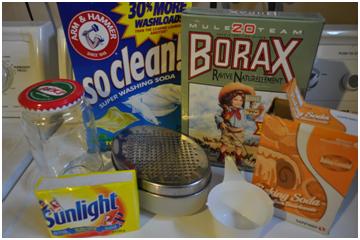
Make your own laundry detergent. This is really easy, I have been doing it for over a year now. It takes about 10 minutes and lasts about 4 months. I don’t mess around with the liquid detergent recipes, I go straight for the dry ones. I just let the detergent dissolve in the water a bit before putting the clothes in. My clothes come out clean and I use ingredients I understand, like plain bar soap, baking soda and borax. I use recipe #4 or #9 from Tipnut. My fave is #9, here is what you need to make it:
Here it is all finished. You only need 1/8 cup per wash. It is literally pennies a wash. Plus there is no throw-away plastic container.
If you don’t make it, then you buy the ultra greenie type of washing detergent at the store. No bleach (dioxins are bad).
Ultimate
You line dry your clothes. Most of the world does this anyway. Most of our grandparents did this. Australia does this. For some reason Canada seems to have a hardcore dryer culture. Maybe it is because it is too cold to dry our clothes outside for over the half the year. I line dry inside, it works like a charm. I would even go as far as to say that line drying INSIDE in the winter is EASIER because the clothes dry FASTER. Like in 12 hours. Dry, done, folded. But that is winter. In spring, it is more like 24 hours.
So I have not turned my dryer on in over a year. It took a few months to give it up all together. Now it just sits there but does make a very nice surface on which to fold clothes.
Sometimes I will pull sheets out of the closet that I have not used in a while and put them on the bed and smell that outside smell all around them and just close my eyes in that dreamy way those chicks in those laundry commercials do when they smell their chemically scented laundry… Ahh, freshness.
I also like folding line dried laundry. It is not all crumply. It is smooth and straight and slightly crisp. My t-shirts come out looking ironed. Everything folds up easy and fast. Also when you wear the clothes, they are crisp and fresh and I just like it better now.
The best part is the electricity savings. Here is a graph of two years of electricity use at my house (I am nerdy with a spreadsheet that way). I switched all my lightbulbs to compact fluorescent and turned off the dryer late in 2010, so the blue bars on the graph is old way of doing things, the red is new. I am not sure how much of the drop is due to light bulbs or laundry, but those are the only two big things I changed.
When you run the math (which I did, since I am an accountant and all) I saved 22% in electricity. So easy. Done. Waste not.
Bonus Points
Do you get any bonus points?
You wash in cold water. I admit, I do not do this in the winter. The water here is so cold here it hurts your hands. Seriously! In summer it is a more reasonable cold. Lately I have been putting a bit of warm in, letting the soap dissolve, then switching to cold. Seems to work.
You wash more often and buy less clothes. This is more related to cutting some consumerism habits vs. greening your laundry. But I thought I would just throw it there in for good measure.
You have been known to pick off an unknown crusty bit from a sweater so you could wear it again without washing. Secretly.
So where do you fall on the sliding green scale – dabbler, beginner, intermediate, hardcore or ultimate? Do you get bonus points? Any change for the green is a good change, no matter how small. So take the poll, check all that apply:
I wonder where this will all go.
Where I will be,
How I will contribute.
Will I be ready if necessary?
Will my children?
How we leave this world?
How will it all end?
Part of me wants to write a book. Part of me wants to scribe this experience, with the hopes that others will learn from it. How much value would that add? Would it even make a difference?
Part of me wants to walk through the halls of higher learning. I want to understand the issues we are facing in detail. I want to be an expert. Perhaps then people will listen to me? Perhaps then I can divert my full energy to making a difference?
Part of me wants to start a non-profit organization, promoting local food and local artisans. Perhaps by facing our consumption habits head on, will we realize that true happiness can only be found through connections with others and with nature?
Part of me wants to work for a non-profit organization, pouring my energies into solutions for change, for the good of all, for our communities, for each other. Can I use my background as a stepping stone to get there?
These are the choices before me. Which path I will take, I do not know.
It has been a bit quiet on this blog lately. Christmas is always a busy time, and this year it was blow the top off busy (something to do with trying to make all my gifts). Once the new year rolled around, there was another project that had to get done, quickly, urgently, and the race continued.
Have you ever felt like you were sprinting, and despite the pain, relished in the fact that it will be over quickly, and then realizing that no – um, sorry – this is a marathon and it will not be over anytime soon.
Today, this very afternoon, I finally feel like I can catch my breath.
Layered on top of all that busy-ness, is my constant awareness of the sad state of the environment. The world is running out of water, is running out of arable land, running out of atmospheric space for carbon, running out of community, and is instead going to the mall to make it all seem okay. Everything is upside down. It is hard to look all around you and realize this, and stay happy.
Sometimes I want to crawl into a metaphorical bubble, with me and my kiddies and my husband and my family and just forget it all. I want to forget where we are, I want to forget about where we are heading, I just want to bury my head in the sand and not think about it anymore. It is so depressing. I want to go back to – before.
But here we are, here today, and there are pressing issues that need to be solved right now, right away. I feel so overwhelmed by my personal responsibilities of running a low footprint household, raising happy children, and maintaining other job responsibilities that there is just no time for other things. Like lately – this blog. Or even more importantly – pitching in to help get us to where we need to go.
If someone like me, who is so passionate about it, who lives and breathes it every day, all day, cannot find the time to get some stuff done – how will others do it? Maybe others don’t have kids, or maybe others don’t feel so overwhelmed and can manage it better…
I can’t even really listen to the news anymore. Oil sands, pipelines, Republican primaries – just listening to it drives me batty. Sometimes I just need to tune out. Sometimes I just want to go somewhere and pretend this is all not happening.
But I know I can’t.
Something inside me cries out. I know these issues are huge and powerful and scary. I know I am just one small person, already stretched so thin. But still…
Another year, another time for reflection. Did I accomplish the things I set out to do? In many ways, it was a changing year in my life, where I modified my habits and my thinking and my way of living. I saw the world in a different light. I saw the challenge before us, and stepped forward to make a change. I held on to a desperate hopefulness, that the changes I was making would make a difference, somewhere, somehow, beyond my little life, outside my little house.
So did they? I poured so much effort into these changes. I built a garden, not knowing how, but learning along the way. I started making bread and most other things from scratch. I preserved mountains of food, built a cold room… So many projects, so many brand new experiences, all with one goal, all with one end – to reduce the environmental footprint my household has on this fragile world, with the hope and the dream that I could inspire others to do the same.
Over the last couple days, as my hands were busy with these household tasks – kneading bread, hanging laundry on the line – my mind was free to wander and contemplate it all. Were my efforts effective? Has it been worth it?
Sometimes, I waver. I wonder if it is worth fighting for, if the story has already been written. Are the forces against us are just too strong, too well-funded, too entrenched? Will it all not matter in the end anyway? After all, the changes require a such a cultural shift. We will need to define ourselves as citizens instead of consumers, as neighbours instead of individuals, and as part of nature instead of against nature.
Are we up to the task? Can we rise to the challenge? Can we transcend our fate?
I hope.
So for this brand new year, I march on. How can I use my life to make this world a better place? I have drawn up a list of 10 resolutions, as I did last year:
Learn to make soap with a friend
Crochet clothes for my family – slippers, hats, mittens, scarves, sweaters
Expand the garden – grow more food
Expand food preservation – canning, dehydrating and possibly get a pressure canner
Hatch a plan for making/sourcing gifts throughout the year
Increase insulation of the house and add weather-stripping
Join an environmental organization
Write 26 letters to leaders
Get a bike and ride it
Live for today.
What do you resolve to do this new year? Does it bring positive change to your life or to our world?
I leave you with an inspiring song by the Dixie Chicks – I Hope.
Our children are watching us,
They put their trust in us,
They’re gonna be like us.
So let’s learn from our history
And do it differently.










 One Earth to Live